Rooftop solar, DIY panels,
or both. Let’s compare.
If you own your home, you have more options than most. Here’s an honest breakdown of the paths: what each costs, what each saves, and who each is right for.

Good
Yes
$18/mo
See what solar looks like at your exact address.
Enter your address and get a real aerial snapshot, a sun-exposure read, a state legality check, and kit picks, all in about 30 seconds. Free, no email required.
Your two main paths
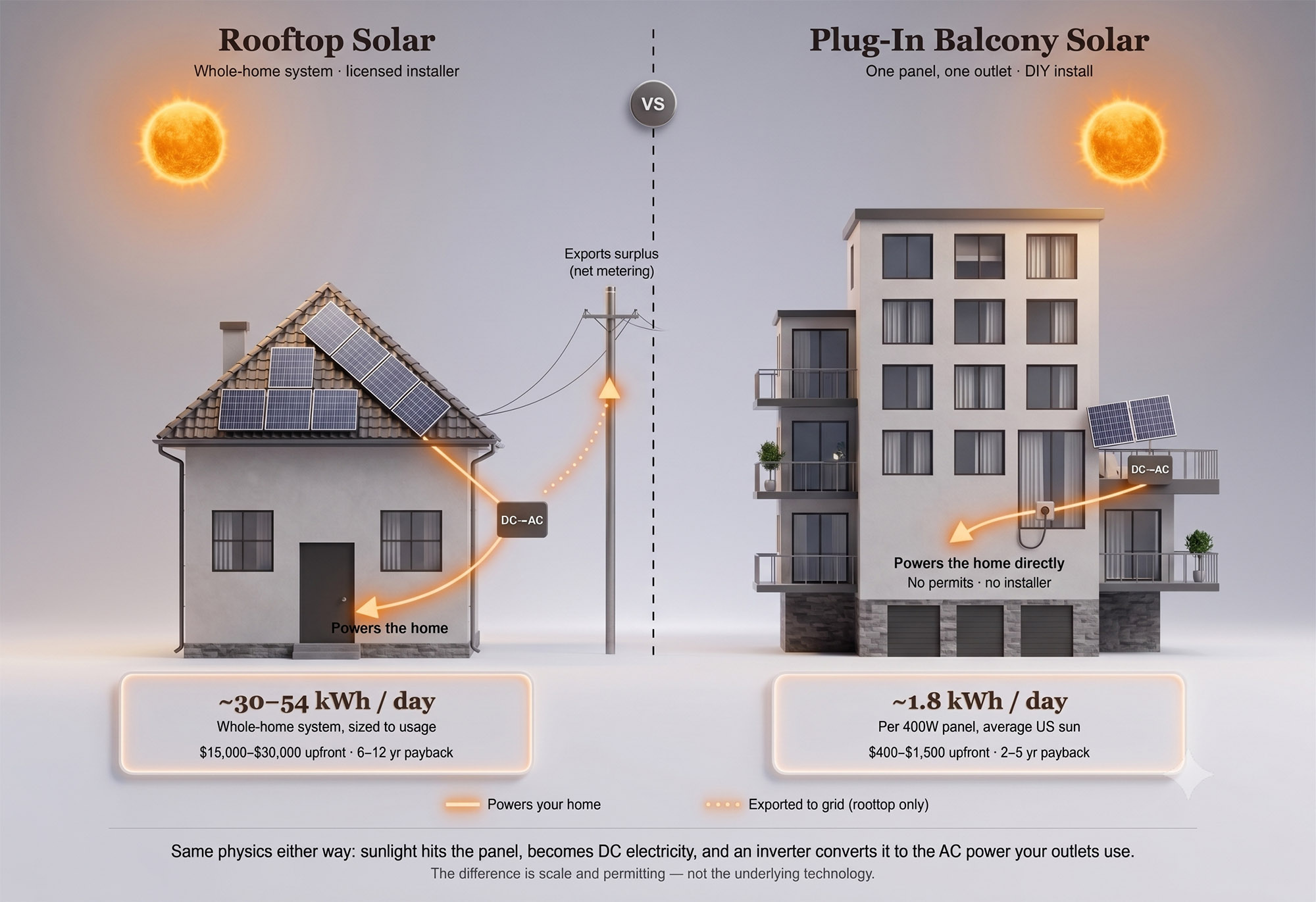
Homeowners can choose between a full rooftop installation (high output, high upfront cost, contractor required) and plug-in solar (low cost, immediate, DIY). They’re not mutually exclusive; many homeowners use plug-in panels while waiting to install rooftop.
When rooftop solar makes sense
Rooftop solar is the highest-ROI solar investment for homeowners, but only if the conditions are right. Here’s the honest checklist.
Good candidates for rooftop solar
You own the home and plan to stay 7+ years. Your electricity bill is over $150/month. Your roof faces south or west and gets good sun. You’re in a state with net metering or a state solar tax credit; the federal credit that used to apply here ended for owned residential systems on January 1, 2026.
When to wait or skip
Your roof needs replacing soon. You’re planning to sell in under 5 years. Your utility has low rates or unfavorable net metering. Your roof is heavily shaded by trees or a neighboring building.
Get quotes from multiple installers before you sign anything. Rooftop solar pricing varies enormously for the exact same equipment; getting 3–4 quotes typically saves $3,000–$8,000 on a typical system. EnergySage is the platform most independent solar coverage points people to for comparing vetted-installer quotes side by side, at no cost.
How to read a quote without getting fleeced
Rooftop solar pricing is opaque by design; the same system can be quoted at wildly different prices depending on who’s selling it. A few things to check before you sign anything.
Do the price-per-watt math
Divide the total quoted price by the system size in watts. Nationally, installed rooftop solar runs somewhere around $2.50/watt before incentives, consistent with the $15,000–$30,000 range for a 6–12kW system on this page. A quote well above that deserves a second opinion.
Red flags to watch for
High-pressure “sign today or lose the discount” tactics. Vague equipment lists with no named panel or inverter model. Production estimates with no methodology behind them. And any claim of a personal federal tax credit on a system you own: that credit ended January 1, 2026, so any installer still pitching it is either out of date or misleading you.
Get the panel and inverter model numbers in writing. A legitimate installer will tell you exactly what hardware they’re quoting (brand, model, and warranty length) before you sign. If they won’t, that’s your answer.
What money is available, honestly
Federal ITC: ended for owned systems
The 30% residential Investment Tax Credit (Section 25D) expired December 31, 2025 under the One Big Beautiful Bill Act. Homeowners who buy or finance a system outright in 2026 get $0 in federal credit, for rooftop or plug-in alike. A separate commercial credit (Section 48E) still runs through 2027, which is why leased and PPA systems (owned by a third party, not you) may still carry a lower effective price. Confirm directly with any installer quoting you a “tax credit” discount; it’s the leasing company’s credit, not yours.
State incentives
With the federal credit gone, state programs matter more than ever. Several states still offer their own tax credits or rebates; check DSIRE (dsireusa.org) for what’s current in your state, since this changes often.
Utility rebates
Many utilities offer installation rebates of $200–$1,000 independent of tax incentives. Call your utility and ask. These are often underused because they’re poorly publicized.
Cash, loan, or lease? This calculus changed in 2026: since the personal 30% tax credit is gone, paying cash or financing with a solar loan no longer comes with a tax credit attached; you’re paying full price, but you keep 100% of the savings and the system adds home equity. A lease or PPA needs $0 down, and the leasing company can still access a separate commercial credit (which may show up as a lower monthly rate), but they keep it, and leases can complicate selling your home since a buyer has to qualify to take over the lease. Cash or a loan still usually wins on total lifetime savings if you can afford it, just not because of a personal tax credit anymore.
Plug-in solar as a complement or starting point
Many homeowners use plug-in solar as a bridge: start generating savings now, while you get rooftop quotes or wait for the right time to install. It also works as a permanent supplement: a couple of panels on a south-facing wall or ground mount can meaningfully reduce a smaller household’s bill forever. Whichever way you use it, check that the kit’s inverter carries UL 1741 certification, the established safety standard for grid-connected inverters. A newer standard written specifically for plug-in solar, UL 3700, has so far been certified on only two microinverters and no complete kits.
Bridge strategy
Buy a $600–$1,000 plug-in kit now. Start saving $30–$80/month. Use that time to research installers, check your roof condition, and compare quotes. Kit pays itself back in 2–3 years regardless.
Permanent ground or wall mount
Ground-mounted panels on your property need no roof access. 2–4 panels can cover 10–30% of a typical household’s usage. You can run longer cable runs to get better sun exposure.

