You don’t need to
own your roof to go solar.
Plug-in solar panels work in apartments, on balconies, even in north-facing windows. Here’s everything, honestly, for renters.

Good
Yes
$18/mo
See what solar looks like at your exact address.
Enter your address and get a real aerial snapshot, a sun-exposure read, a state legality check, and kit picks, all in about 30 seconds. Free, no email required.
Do you need your landlord’s permission?
In most states: it depends on your lease. Nine states have enacted plug-in solar laws, but only four of them limit what a landlord can do, and three of those four haven’t taken effect yet. Everywhere else, your lease is the real question. (See the full state-by-state tracker for where things stand today, or read our breakdown of how many Americans that already covers.)
Here’s the short version:
4 states: Renter protections
Vermont (in effect now), Colorado and Virginia (from January 1, 2027) and New Jersey (from March 1, 2027) limit what a landlord can do. Landlords can still set reasonable rules on size and placement, and you give them notice first. (Vermont, Colorado and New Jersey also stop HOA bans; see our HOA & condo playbook for the details and a sample approval letter.)
Everywhere else: Check your lease
That includes Utah, Maryland, Maine, Connecticut and New Hampshire, whose plug-in solar laws cover the utility but not landlords. If your lease prohibits exterior modifications, that clause applies. Many leases don’t address balcony panels at all, which usually means you can install one.
2 bills pending
California and New York have passed their legislatures and await governor signatures. Governor Newsom has until September 30 to act on California’s bill, and if he does nothing, it becomes law anyway.
The framing that works: “I’m adding a solar appliance to my balcony. It plugs into the outlet, takes 20 minutes to set up, and I take it when I leave.” This framing (appliance, not installation) is how renters get quick yes answers.
Which type of setup fits your situation?
Not all rentals are equal. Here’s what actually works in different living situations.
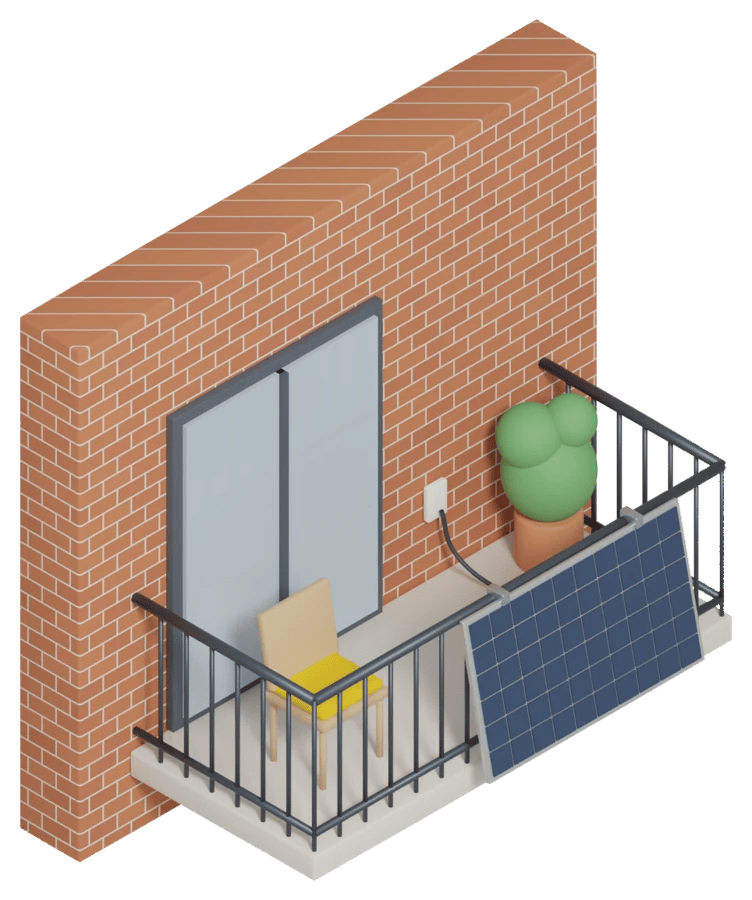
Balcony or patio
The ideal setup. A railing-mounted panel or free-standing ground mount. South, east, or west-facing. One 400W panel can save $5–23/month in a typical state. Two panels is the sweet spot for most renters.
Window or windowsill
Window solar panels exist for apartments with no outdoor access. Output is lower; expect 60–150W from a large south-facing window. Still meaningful if your electricity rate is high.
No balcony, no window
Community solar is probably your best path. You subscribe to a local solar farm and get a credit on your bill: no hardware, no installation, just a lower bill each month.
What will it actually save you?
Solar savings depend on three things: your electricity rate, how much sun you get, and how many panels you have. Here’s what’s realistic for a typical renter with one or two 400W panels.
The best plug-in solar kits for renters
The market is still early, so we only recommend three kits: the same three we’d point any reader to on our full kit comparison. All three meet the UL 1741 safety standard for grid-connected inverters. (You may see mention of UL 3700, a newer standard written specifically for plug-in solar. As of September 2026, two microinverters, the APsystems EZ1 and the Hoymiles HiFlow Pro, carry UL 3700 certification from CSA Group, but no complete kit has been certified as a whole system yet.) For a broader look at what’s coming next (battery-integrated kits, smarter inverters), see our hardware roundup.
US Solar Supplier 810W
Best overall. Two 405W panels with an APsystems EZ1 dual-MPPT microinverter, the same platform behind over a million European balcony systems. ~$969. Ships complete with racking and cable.
PLUGGEDSOLAR 800W
The Amazon pick. Four 200W panels, Wi-Fi monitoring, Prime shipping and easy returns. $1,395. Slightly higher cost per watt than the US Solar Supplier kit.
CraftStrom 800W
Zero-export design: never pushes power back to the grid, so it works without a state law or utility approval in all 50 states. Bifacial panels. $2,031, 3–4 week lead time.
Before you buy: Check your utility’s rules on “microgeneration” or “plug-in solar.” Most allow it. Some require notification. A zero-export kit like CraftStrom sidesteps the question entirely. Full specs, pros/cons, and buying links are on our Recommended Kits page.

