← The Current · October 26, 2026 · Buying guide · 6 min read
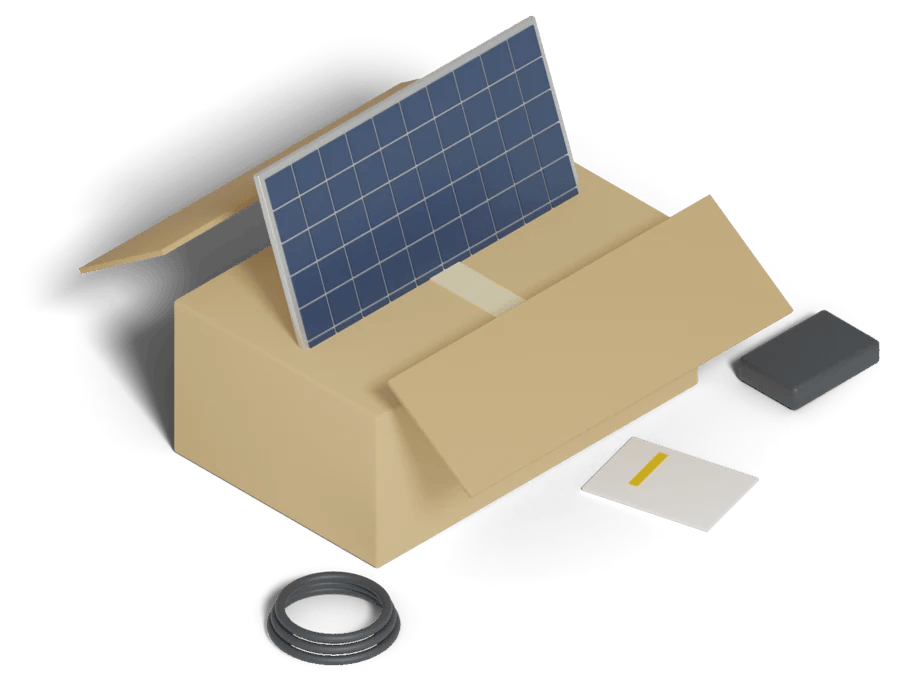
Black Friday is the first big shopping weekend since plug-in solar became legal in ten states, and you’ll see a lot of panels marked down. Some of those deals are great. Some are big batteries and folding camping panels dressed up as balcony solar. Here’s how we’d shop this year, which kits we’d actually buy, and why buying in November to plug in on January 1 makes a lot of sense.
The short version. Check that plug-in solar is protected where you live (or will be on January 1). Buy certified equipment and compare price per watt, not the sticker. Our picks: a US Solar Supplier kit built on Hoymiles microinverters for the best value, Bright Saver for the easiest start on a balcony, a bigger APsystems kit for patios and yards, and CraftStrom if your state has no law yet. All four are on our recommended kits page. Skip grid-tied plug-in batteries for now. Prices below are what we saw in late October and will move over the holiday weekend.
First, make sure the timing works for you
California, Virginia and New Hampshire start their plug-in solar laws on January 1, 2027, and Colorado’s renter and HOA protections start the same day. New Jersey follows on March 1. If you live in one of those states, a holiday purchase is well timed: it arrives, you read the manual, you plug it in on New Year’s Day. If your state has no law yet, it’s still worth reading our tracker first, because the rules are different everywhere.
How to tell a real deal from a fake one
- Divide the price by the watts. A kit’s price per watt is the fairest way to compare. The kits we recommend run from about 71 cents to $2.70 a watt, so a sticker price alone tells you very little.
- Look for a real lab certification. A listing that says compliant isn’t saying certified. Look for UL or another nationally recognized lab on the inverter, and ideally a plug-in standard like UL 3700, which so far covers only a couple of microinverters.
- Check that it’s grid-tied and plugs into a wall outlet. Many discounted solar panels are built to charge a portable power station, not to feed your home. Those are useful for camping and outages, but they won’t lower your electric bill.
- Read the return window. Panels are big and heavy. Make sure you can send one back if it doesn’t fit your railing.
The kits we’d buy
- Best value: US Solar Supplier 880W Hoymiles kit. Two 440-watt panels, each with its own Hoymiles HiFlow Pro LV microinverter, the first microinverter certified to UL 3700 (as a component). We saw it at $629, about 71 cents a watt, which is remarkable. Mounting is sold separately, the panels are full size, and it plugs in as two devices, so check your state’s one-device rule. US Solar Supplier
- Easiest start: Bright Saver Balcony Kit. A California nonprofit that sells its kit at cost: $285.30 for 180 watts or $414.17 for 360 watts with a membership from $29 a year ($499 without one). The panels are light and glass-free, sized to sit safely on an ordinary household circuit, and use the same certified Hoymiles microinverter. It ships only to Utah, Virginia, Colorado, Maryland, Connecticut, New Hampshire and New Jersey for now, with the next batch arriving in early November. Bright Saver
- Most output: US Solar Supplier 1180W APsystems kit. Two 590-watt panels on one APsystems EZ1-LV microinverter (reported certified to UL 3700) that sends up to 900 watts through a single plug. We saw it at $899, or $1,079 with mounting. These are big panels for a patio, yard or flat roof, not a railing. US Solar Supplier
- If your state has no law yet: CraftStrom 800W. A Houston company whose kit uses a zero-export meter so it doesn’t push power back to the grid. It’s the priciest pick (about $2,158, or $2.70 a watt), and the company describes it as UL 3700 compliant rather than certified, so read the fine print. CraftStrom
The full comparison, with savings estimates and which kit fits which state, is on our recommended kits page.
What we’d skip this year
- Grid-tied batteries sold as plug-and-play. The newest European balcony batteries are impressive, but in the US they generally need a professional install to be connected legally. Wait for clearer rules.
- Kits above your state’s limit. Most laws cap you at 1,200 watts per home (Colorado allows 1,920). Bigger isn’t better if it isn’t allowed.
- Anything without a certification you can verify. If you can’t find the lab listing, keep shopping.
Not sure how much a kit would save you?
Put your address into the Solarly Advisor. It reads the sun at your exact spot, checks your state’s rules and tells you what a panel would save at your electricity rate, in about 30 seconds. Happy shopping!
Disclosure. Some links on Solarly are affiliate links. If you buy through them, we may earn a small commission at no cost to you. It never changes what we recommend or how we describe it.
Sources. Bright Saver and CraftStrom product pages, checked October 25, 2026; pv magazine USA; TechRadar.
By Ben van der Veen. Solarly is independent and reader-supported.



Leave a Reply