
← The Current · October 26, 2026 · State laws · 5 min read
Until this month, every plug-in solar law in the country was written in a statehouse. On October 19, Representative Rob Menendez of New Jersey introduced H.R. 10851, the Socket Full of Sunshine Act, the first plug-in solar bill in Congress. It wouldn’t make plug-in solar legal everywhere on its own. What it would do is push every state to take a serious look, pay for rebates of up to $1,000 for lower-income households, and tie that money to something only four state laws do today: protecting renters from a landlord’s flat no.
The short version. Introduced October 19, 2026, in the House. Every state utility commission would have to consider plug-in solar rules (states that already passed a law, or recently voted on one, are exempt). Rebates of up to $1,000 for low- and moderate-income households, funded at $100 million a year from 2027 through 2032, but only in states that stop landlords from banning plug-in solar for tenants who pay their own electric bill, and only for kits with more than 55% US-made parts. Its odds this session are slim: Congress has a few weeks after it returns in mid-November, and bills that haven’t passed expire on January 3, 2027.
What the bill would actually do
- It would make every state take a look. Each state’s utility commission would have to formally consider letting people use a plug-in kit without an interconnection agreement, utility approval, fees, extra insurance or extra equipment. Consider is the key word here: states would have to review the idea, not adopt it.
- It would define what counts. Up to 1,200 watts, a standard 120-volt outlet, the National Electrical Code, and certification by UL or a similar lab. Anything 400 watts or more would also need a built-in power control system. That lines up closely with the ten state laws already on the books.
- It would pay for rebates. The Department of Energy would get $100 million a year from 2027 through 2032, about $600 million in all, for state rebate programs worth up to $1,000 per household. Income would be checked at checkout, and renters, apartment dwellers and communities with high energy bills would come first.
- It would write a national safety standard. The Consumer Product Safety Commission would develop one for plug-in devices, sellers would have to explain installation, warranty and expected savings, and manufacturers could add an optional savings label modeled on the yellow EnergyGuide tag you see on a new refrigerator.
The renter clause is the real story
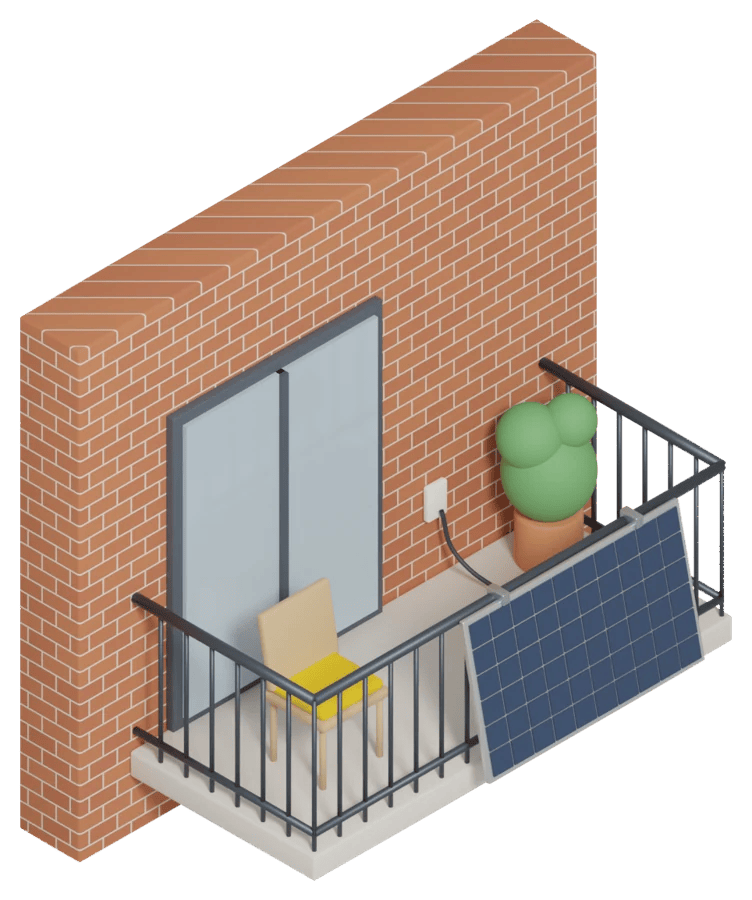
Of the ten state laws, only four (Vermont, Colorado, Virginia and New Jersey) limit what a landlord can do. California’s new law, the biggest of them all, says nothing about landlords. This bill would use money as the lever: a state could only hand out the rebates if its rules stop landlords from banning plug-in solar for tenants who pay their own electric bill, balconies and patios included. Landlords could still set reasonable limits on size and placement.
If you rent, that’s the part to watch. A utility that can’t block you doesn’t help much if your lease can, and this is the first time anyone has tried to fix that gap nationally.
The catch: more than half made in America
Rebates would only apply to kits with more than 55% of their components made in the US. That’s a high bar for a market this young. Most of the kits sold here today are built around imported panels and microinverters, including the microinverters certified so far to UL 3700, the new plug-in safety standard. A rule like this could pull manufacturing home over time, but on day one it could leave the rebate with very little to spend on. If the bill moves, expect that number to be argued over.
Will it pass?
Probably not this year, and that’s okay. It would have to clear the House Energy and Commerce Committee and the full House, there’s no Senate version yet, and Congress comes back from its election break in mid-November with only a few weeks left before the session ends on January 3, 2027. Even if it passed, Congress would still have to fund the rebates every year.
The more realistic path is a fresh version in 2027, ideally with a Senate partner. What the bill does right now is plant a federal flag. A year and a half ago, one state had a plug-in solar law. Now ten do, and the idea has reached Congress!
What this means for you today
- Nothing changes yet. Whether plug-in solar is protected where you live still depends on your state, and our state law tracker has every law and bill.
- If you live in one of the ten states, your state law already applies, or will soon: California, Virginia and New Hampshire start January 1, 2027, and New Jersey follows on March 1.
- If you want to weigh in, your representative in the House is the person to tell. A short, specific note about how plug-in solar would help your household goes further than you’d think.
Sources. pv magazine USA; Solar.com; H.R. 10851 bill summary, Quiver. Checked October 25, 2026.
By Ben van der Veen. Solarly is independent and reader-supported. This is our reading of the bill as a guide for households, not legal advice.


Leave a Reply