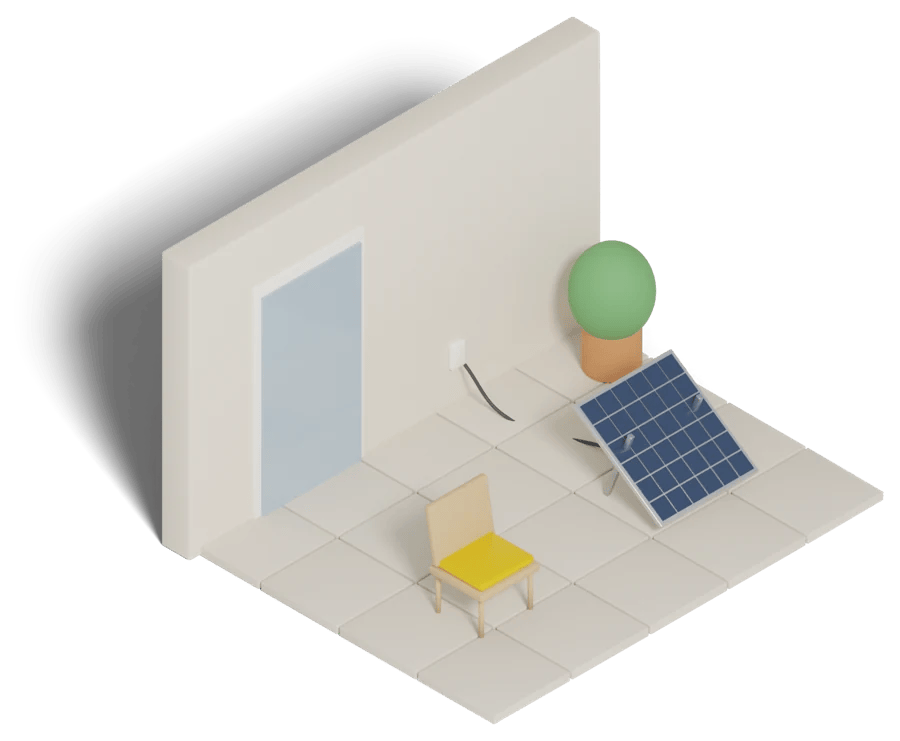
Every plug-in solar site, including ours, tells you to check UL 3700 certification and check your state’s balcony solar law. Almost none of them tell you what to do about your insurance policy: whether you have to say anything to your insurer, who eats the cost if a panel falls off a railing, or whether a landlord’s building policy covers equipment a tenant plugged in. We went looking for real answers. Some exist. Several don’t, and we say so plainly below rather than inventing a confident answer where the sourcing won’t support one.

Photo: Yuma Solar / Unsplash
Do You Have to Tell Your Insurer?
The general-purpose solar-and-insurance content out there, written mostly for roof-mounted, permitted systems, is fairly consistent on one point: you should notify your carrier when you add solar equipment to a property, and failing to do so can create coverage problems if you ever file a claim. Insurers like Progressive and sites like EnergySage and Openly all frame notification as good practice, and some describe it as close to mandatory for maintaining full protection.
What none of that content was written for is a $200–$1,500 kit that clips onto a railing and plugs into an outlet, with no permit, no electrician, and often no structural change to the building at all. We could not find a major insurer that publishes balcony-solar-specific underwriting guidance, and we could not find a state balcony solar law (not New York’s SUNNY Act, not California’s SB 868, not New Jersey’s new Garden State Balcony Solar Act) that says anything about insurance notification one way or the other. Legalizing an installation and satisfying your insurance contract are two separate things, and the laws only do the first one.
Homeowners and renters insurance policies vary by carrier, by state, and by the specific language in your policy; we can’t tell you what your policy says, and neither can any other blog. Some carriers may treat a plug-in kit as ordinary personal property that’s already covered; others may want it disclosed, especially once it’s mounted outside the unit. The only way to know for certain is to call your own agent and ask before you install, not after something goes wrong. We give you a script for that call further down.
Who’s Liable if a Panel Falls, Sparks a Fire, or Damages Property?
Liability for a falling or malfunctioning panel generally follows ordinary premises-liability and product-liability principles: whoever owned, installed, or was responsible for maintaining the equipment can be held responsible if it was defectively designed, improperly mounted, or poorly maintained, and installers can face direct liability for negligent installation. None of that is specific to plug-in solar; it’s the same framework that applies to any equipment attached to a building. In practice, for a DIY-installed balcony kit, that responsibility usually lands on whoever mounted it: typically the resident, unless a landlord or HOA required or performed the installation.
One widely covered case illustrates the stakes, though we want to be precise about what it does and doesn’t tell us: in late 2025, a large solar panel detached from a steel carport structure during high winds in Brooklyn and fatally struck a pedestrian. That was a carport-mounted commercial installation, not a plug-in balcony kit, and we haven’t found evidence it involved a UL 3700-class product. We’re including it because it’s the clearest real-world example of what “a panel falls and someone gets hurt” actually looks like in liability terms: property owners and installers facing wrongful-death claims over securing and maintenance, not because it’s a plug-in solar incident. Treat it as illustrative of the general risk category, not as a plug-in solar statistic.
What UL 3700 actually changes
UL 3700, published in December 2025 as the first U.S. safety standard written specifically for plug-in solar, requires several protections that matter for liability exposure: automatic power cutoff that de-energizes the plug prongs in under a second once unplugged, anti-islanding protection that shuts the system down during a grid outage (protecting utility workers), ground-fault protection, and overload/reverse-current prevention. Those features are aimed squarely at electrical hazards: shock and fire risk from a live plug or a fault in the system. If a certified unit does what it’s supposed to do, it meaningfully reduces the odds that a plug-in kit causes an electrical fire or shocks someone, which is the liability scenario most directly tied to the equipment itself.
What UL 3700 does not cover is the mechanical question of whether the thing stays on the railing. The standard requires manufacturer installation instructions that account for wind, snow, seismic, and gravity loads consistent with building code, but it explicitly does not evaluate the structural integrity of the building component the system is mounted to: the balcony railing itself. In plain terms: a UL 3700 certification tells you the electronics are unlikely to burn your apartment down. It does not tell you the railing can hold the panel in a storm, and it doesn’t relieve whoever mounted it of the ordinary duty to install it securely and follow the manufacturer’s instructions. That’s a meaningful liability distinction worth understanding before you assume certification covers you against every failure mode.
The Script: What to Ask Your Insurance Agent
Call before you install, not after. Here’s a short script covering what we think are the load-bearing questions; adapt it to your policy type and your specific kit.
-
1. “Does adding this change what my policy covers?”
Describe the kit plainly: wattage, whether it’s mounted to a railing or freestanding, and that it plugs into a standard outlet with no electrician or permit involved. Ask directly whether this needs to be added, scheduled, or disclosed.
-
2. “Is it covered under personal property, or do I need a separate rider?”
For renters and homeowners alike, ask whether the kit falls under existing personal property coverage limits or whether it needs its own endorsement, and whether there’s a per-item cap that a several-hundred-dollar kit might bump against.
-
3. “What’s my liability exposure if it falls or causes damage?”
Ask specifically about liability coverage, not just replacing the panel, but paying out if it damages a neighbor’s property, a parked car, or injures someone below.
-
4. “Does certification status matter to you?”
Ask whether the carrier treats UL 3700-certified equipment differently from uncertified equipment for underwriting or claims purposes. We could not confirm that any major insurer has a formal position on this yet, but it costs nothing to ask, and their answer may change as certified products reach the market.
-
5. “Do I need my landlord’s or HOA’s written approval on file?”
Some carriers may want documentation that the installation is authorized, independent of what state law allows. Ask what paperwork, if any, they’d want if you ever filed a claim.
Renters: Does the Landlord’s Policy Cover This?
Almost certainly not, and this is one of the more consistent findings in our research. A landlord’s building or dwelling policy is built to cover the structure and the landlord’s own property; it’s not designed to cover a tenant’s belongings, and standard landlord policies generally exclude tenant-owned personal property outright. A plug-in solar kit that a tenant bought and mounted is, in insurance terms, tenant property sitting on the landlord’s structure, not something the building policy was written to protect.
That gap is exactly what renters insurance exists to fill, and it’s worth treating a balcony kit the same way you’d treat any other valuable item you bring into a rental: confirm it’s covered, and ask whether it needs its own rider given that it’s mounted outside the unit rather than sitting inside it. If you don’t currently carry renters insurance, this is a reasonable prompt to get a policy before you install rather than after.
Your lease may separately require landlord sign-off, even in a state that bars outright bans on plug-in solar; several of the pending state laws we track explicitly preserve a landlord’s ability to set reasonable rules on size and placement.
Ask your landlord, in writing, whether their insurer has been made aware that tenants are permitted to mount equipment on balconies. If a claim ever touches the building’s policy, that documentation may matter.
This is not insurance or legal advice. Insurance policies, state laws, and lease terms vary, and the answers above reflect general research, not a review of your specific policy. Talk to your own insurance agent and, for anything involving a lease dispute or an actual injury or damage claim, an attorney licensed in your state. Full state-by-state legal detail lives on our state law tracker; certification notes live on our recommended kits page.



Leave a comment