Correction, September 19, 2026: An earlier version of this article said all five of these laws let renters install without their landlord’s permission. That was wrong. Only Colorado’s and Virginia’s laws limit what landlords can do, and both of those protections start January 1, 2027; the Utah, Maine and Maryland laws take the utility out of the way but don’t address landlords. We’ve corrected the state summaries below. The count has since grown to nine states, and our state law tracker has the current picture.
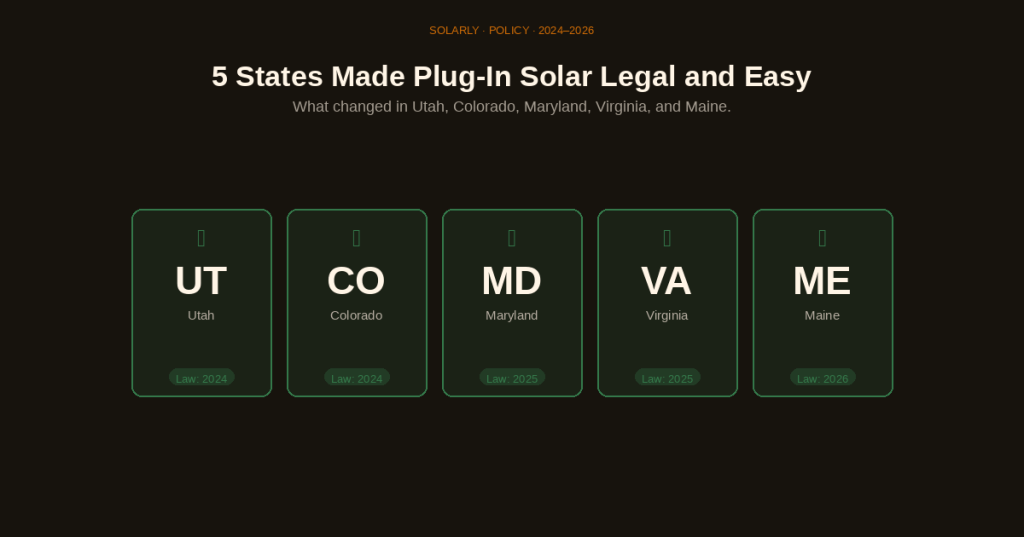
As of 2026, five US states have enacted plug-in solar laws: Utah (March 2025), Colorado, Maryland, Virginia, and Maine (all 2026). In these states, you can install a plug-in solar system without your utility’s approval. Only Colorado and Virginia also limit what a landlord can do, and both of those protections start January 1, 2027.
Between 2025 and 2026, a wave of state laws quietly rewrote the rules for renters and small-scale solar. What passed, what it means, and what’s still coming.
For most of solar’s history, the rules were simple: if you didn’t own your roof, you were out. Plug-in solar existed, but utilities could, and often did, prohibit it. Landlords could say no. HOAs could block it. Nobody was obligated to let you generate your own power.
That’s changing. Five states have now passed laws that specifically protect plug-in solar users, with more on the way. Here’s what actually happened.
The five states that signed laws
Utah Signed March 2025
Utah was the first state to explicitly protect plug-in solar at the legislative level. HB 340 lets anyone install a certified plug-in system of up to 1,200 watts without utility approval, an interconnection agreement, or fees. It doesn’t address landlords, so a lease can still say no. Effective May 2025.
Maine Signed April 2026
Maine’s law takes the utility out of the way: no approval, interconnection application or fees. Systems up to 420 watts need no paperwork; larger ones, up to 1,200 watts, must be installed by a licensed electrician on a dedicated circuit, with the utility notified within 30 days. The law doesn’t address landlords. Effective July 2026.
Virginia Signed April 2026
Virginia’s law bars landlords who own more than four rental units from prohibiting a tenant’s plug-in system, though they can set reasonable rules on size and placement, and tenants give 7 days’ notice first. Utilities can’t require approval or charge fees, but you notify them on a state form before installing. Effective January 1, 2027.
Colorado Signed May 2026
Colorado’s HB26-1007 is notable for two reasons. First, starting January 1, 2027, it stops landlords and HOAs from unreasonably prohibiting plug-in solar. Second, it has the highest wattage ceiling of any US state: 1,920 watts, 60% above the 1,200W standard. Landlords and HOAs can still set reasonable rules, but they can’t say no categorically.
Maryland Signed May 2026
Maryland’s Utility RELIEF Act (HB 1532) includes a short plug-in solar section: no utility approval, no fees for power you send back, and no extra equipment requirements, as long as you notify your utility before installing. It doesn’t address landlords.
If you’re in one of these five states: your utility can’t stand in the way. Your landlord still can in Utah, Maine and Maryland, and in Colorado and Virginia until January 1, 2027. Most cap systems at 1,200W; Colorado’s 1,920W limit is the national high.
What’s coming next
SB 868 passed the Senate 35–1 and cleared Assembly committees unanimously. Awaiting Governor Newsom’s signature, with an October 2026 deadline. Would cover a state with roughly 17 million renters.
The SUNNY Act passed both the Senate and Assembly on May 28, 2026 and is awaiting Governor Hochul’s signature. New York City alone has about 2.3 million renter households.
HB 5340 passed both chambers June 4, 2026 and awaits the governor’s signature. Like Maryland’s law, it takes the utility out of the way for systems up to 1,200W.
What these laws don’t do
These laws don’t force utilities to offer net metering for plug-in systems; your savings come from offsetting consumption in real time, not selling power back. They don’t cover interior apartment units with no outdoor space. They don’t apply in states that haven’t enacted them. And Virginia’s protections don’t take effect until January 1, 2027.
If you’re not in one of these states
In most other states, the picture is blurrier. Some utilities are permissive. Some landlords don’t care. But you don’t have a legal backstop if someone objects.
The practical reality: many Americans are running plug-in solar panels without issue in states with no specific law. But if your lease prohibits modifications or your HOA is active, check before you buy. And check our state law tracker; 22 more states have active bills as of mid-2026.




Leave a comment