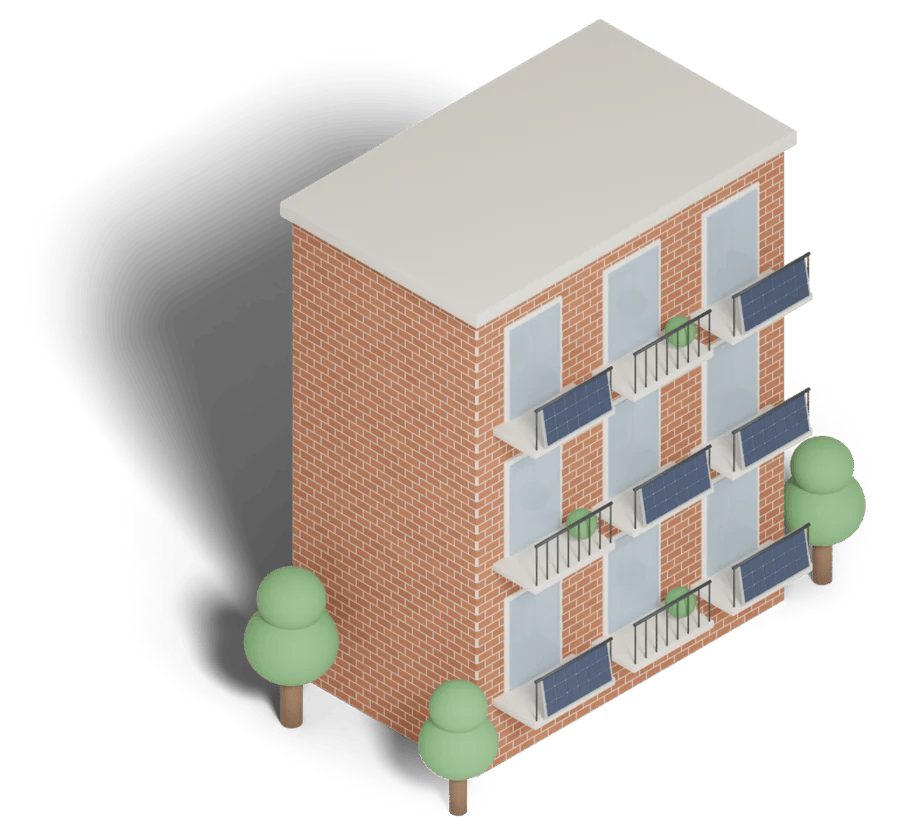
Germany now has more than a million balcony solar systems plugged into ordinary apartment outlets, and the boom didn’t happen by accident. Simplified registration, higher wattage caps, retail distribution through supermarkets and hardware chains, and a law that curbs landlord vetoes all did real work. Here’s what that record actually shows, and where it does and doesn’t map onto the wave of US state laws Solarly tracks.

Photo: Yuma Solar / Unsplash
How Big Is Germany’s Balcony Solar Boom, Really?
Balkonkraftwerke (literally “balcony power plants”) are small plug-in solar setups, usually one or two panels feeding a microinverter that connects straight into a household outlet. Germany didn’t invent the concept, but it has done more than any other country to normalize it at national scale, and by 2026 the count of registered systems has climbed past the million-and-a-quarter mark.
Independent analysis of Germany’s public Marktstammdatenregister (MaStR), the federal register where every generation asset, balcony solar included, must be recorded, put the operational count at roughly 1.33 million systems as of May 2026. Growth has been steep and sustained rather than a one-year spike: MaStR data shows about 433,000 new systems registered in 2024 and a further 430,000 in 2025, averaging over 1,100 new registrations a day in the second year running. Germany’s numbers come from the Bundesnetzagentur registration data that underpins the MaStR registry; the best independent testing of balcony solar hardware is HTW Berlin’s balcony solar research group.
The 1.3 million figure comes from third-party analysis of public MaStR records (reported by outlets including GFK Solar and The Local), not a single official monthly government tally we’ve verified directly ourselves. Germany’s own consumer and industry groups have long noted that the true installed count is almost certainly higher, since registration, while mandatory, isn’t perfectly enforced and some owners skip it. Treat “1.3 million” as a solid order-of-magnitude figure, not a precise headcount.
What Actually Made This Possible
Germany’s numbers didn’t move because German renters suddenly cared more about clean energy than Americans do. They moved because four specific frictions were removed, roughly in sequence, culminating in the Solarpaket I reform that passed the Bundestag in April 2024 and took effect that May.
-
Registration
Before Solarpaket I, owners had to register with both the MaStR federal database and their local grid operator: two separate processes. Since May 2024, a single free online registration at marktstammdatenregister.de is sufficient for systems under 800W; the grid-operator notification step was eliminated outright.
-
Wattage caps
Solarpaket I raised the inverter’s AC export limit from 600W to 800W, and separately raised the allowed DC panel (module) capacity to 2,000 Wp, enough for two standard 400–500W panels feeding one capped inverter.
-
Landlord and HOA authority
As of October 17, 2024, German tenants and flat owners gained a statutory right to install balcony solar; landlords and owners’ associations can no longer simply refuse a reasonable request outright, though they retain some ability to set conditions on placement and appearance. It’s a right to install with limits, not an absolute veto-free guarantee, but it shifted the default from “ask permission” to “landlord must show cause to refuse.”
-
Retail distribution
Discount grocery chains Aldi and Lidl have run balcony solar kits as limited-time home-and-garden specials that reportedly sold out within days; DIY chains OBI and Bauhaus, and electronics retailers Saturn and MediaMarkt, carry plug-in kits as standard stock rather than a seasonal novelty. That distribution reach did as much to normalize the purchase as any single law.
None of these changes were revolutionary in isolation. Together, they turned balcony solar from a permit-and-paperwork project into something closer to a small-appliance purchase, which is the same threshold US advocates argue plug-in solar needs to cross here.
Germany vs. the Best US State Laws
Solarly’s own state law tracker currently counts nine enacted US plug-in solar laws, with two more awaiting a governor’s signature. No single US state matches Germany on every dimension, but stacking the strongest provisions from Utah, Colorado, Vermont, Maryland, and New Jersey’s new law against Germany’s rules shows exactly where the gap is closing, and where it isn’t.
Germany’s two numbers measure different things: 2,000W describes panel (DC) capacity, while 800W describes what the inverter is actually allowed to push onto the circuit (AC), and AC output is the figure that matters for grid safety. Public summaries of US state bills aren’t always explicit about whether their wattage caps refer to DC panel nameplate or AC inverter output. We haven’t independently confirmed that distinction for every state in our tracker, so read the wattage comparisons above as directionally useful rather than exact apples-to-apples specifications until you’ve checked a given bill’s text.
What US Policy Could Borrow, Carefully
Colorado’s 1,920W cap, signed in May 2026, is the clearest sign yet that US lawmakers are willing to move past the 1,200W figure that dominated the first wave of state laws. New Jersey’s new law, which flatly bars landlord and HOA bans rather than just requiring notice, is the closest any US state has come to Germany’s post-2024 tenant protections. Those two data points suggest a real, if partial, convergence already underway, without any state explicitly citing German law as its model, as far as we’ve found in the bill text or committee reporting we’ve reviewed.
With that in mind, here’s where the German experience seems most instructive, hedged appropriately:
-
Simplify registration into one government step
Several enacted US laws already skip utility pre-approval, which is the functional equivalent of Germany’s simplified process. What’s still missing is anything like a single public registry akin to MaStR. Whether building one would meaningfully help US adoption, versus simply adding a new compliance step, is a genuinely open question we don’t think has been tested at state level yet.
-
Keep testing higher wattage caps, but watch the data
Colorado’s 1,920W law took effect too recently for any published safety or grid-impact data to exist yet. Germany’s 800W AC ceiling has years of operating history behind it; Colorado’s higher figure doesn’t. We’d call this a promising experiment worth watching, not evidence the US should immediately match Germany’s numbers, especially since, as noted above, the two figures may not be measuring the same thing.
-
Close the landlord/HOA loophole nationally
This is the area where Germany’s model looks most directly portable: a right-to-install standard, with landlords retaining reasonable placement conditions but not a flat refusal right. New Jersey’s law and Vermont’s notice-based approach are the two closest US analogs so far; most enacted states haven’t addressed landlord authority at all, which leaves renters, the population plug-in solar was largely designed for, unprotected in practice even where the wattage cap itself is generous.
-
Broaden retail distribution
This isn’t a law US legislators can pass directly, but it’s arguably the biggest lever: Germany’s retailers stocked balcony solar at scale once the regulatory friction was low enough to make it a low-risk product line. As more states remove permitting and utility-approval barriers, mainstream US retail interest may follow, but that’s our inference from the German sequence of events, not a trend we can point to in the US market yet.
Full state-by-state detail lives on our state law tracker. For a plain-language walkthrough of how plug-in solar works, see our solar basics guide; for kit picks and certification notes, see our recommended kits page.




Leave a comment