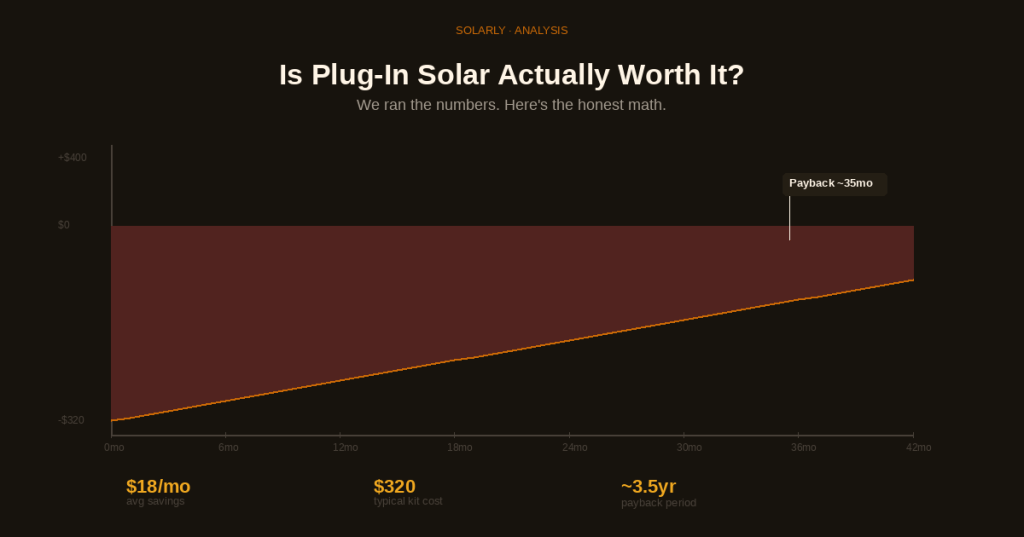
A single 400W plug-in solar panel saves approximately $5–$19/month depending on your electricity rate. At the US average of $0.16/kWh, payback on a $600 kit takes about 6 years. At California’s $0.25/kWh, payback is under 4 years. Hawaii ($0.35/kWh) pays back in roughly 2.5 years. Two panels roughly doubles all figures.
The honest answer depends on where you live, what you pay for electricity, and which direction your windows face. Here’s the math, unvarnished.
Every week someone asks some version of this: “I keep seeing plug-in solar panels: are they actually worth it, or is this just an expensive gadget?”
It’s a reasonable question. A decent plug-in solar kit costs $600–$1,200 upfront. The marketing promises big savings. So let’s look at what the numbers actually say, not in a best-case-scenario way, but in a what-you-might-realistically-expect way.
The basic math
A standard plug-in solar kit includes one 400-watt panel and a microinverter. In full sun, that panel produces 400 watts per hour. But you’re not in full sun all day, and your panel probably isn’t perfectly south-facing.
A realistic estimate uses “peak sun hours”: the average daily hours of useful solar intensity for your location. In the US, that ranges from about 3.5 hours (Seattle, December) to 6+ hours (Phoenix, summer). A reasonable national middle ground is 4–5 peak sun hours.
So: 400W × 4.5 hrs = 1,800 watt-hours = 1.8 kWh per day.
Over a month: 1.8 × 30 = 54 kWh/month.
Now multiply by your electricity rate. The US average is around $0.16/kWh, but it varies enormously: California and Hawaii pay $0.25–$0.35, while the Midwest often pays $0.10–$0.13.
| Electricity rate | Monthly savings (1 panel) | Annual savings |
|---|---|---|
| $0.10/kWh (Midwest) | ~$5.40 | ~$65 |
| $0.16/kWh (US avg) | ~$8.60 | ~$103 |
| $0.25/kWh (California) | ~$13.50 | ~$162 |
| $0.35/kWh (Hawaii) | ~$18.90 | ~$227 |
Two panels change the math significantly. Most balconies can fit two 400W panels side by side. Double the numbers above. At California rates, two panels save ~$324/year; a $1,200 kit pays itself back in under 4 years.
The honest caveats
Shading kills output. If your balcony gets partial shade from a building or trees for a few hours a day, your real-world output can drop 30–60%.
Direction matters a lot. South-facing is best, West is decent, East is okay, North is not worth it unless you’re in Hawaii.
The grid doesn’t pay you back. Unlike rooftop solar with net metering, a plug-in panel offsets your consumption in real-time but doesn’t export surplus to the grid. Anything generated when you’re not home is essentially wasted (unless you add a battery).
When it makes sense
Plug-in solar makes the most financial sense if you’re in a high-rate state (California, Hawaii, New England), have a reasonably south-facing balcony with minimal shade, and plan to stay in your apartment for 2+ years. At $0.25/kWh with two panels, you’re looking at a 3.5–4 year payback, then effectively free electricity for the remaining 20+ years of the panels’ life.
It makes less sense if you’re in a very low-rate state, heavily shaded, or moving soon. At $0.10/kWh, a single panel takes 9+ years to pay back; that’s more of a values purchase than a financial one.
When it isn’t about the math
A lot of people buy plug-in solar because it feels good to generate your own power, even a little bit. The panel on your balcony is tangible: you can watch the numbers tick up on a sunny afternoon. For some people, that’s worth something the spreadsheet doesn’t capture.
Just go in clear-eyed. Use our calculator with your real numbers. If the math works, great. If it doesn’t quite, know what you’re trading off.
A note on tax credits: The federal 30% residential solar tax credit (Section 25D) expired December 31, 2025, and is not available for systems installed in 2026. The savings figures in this article reflect direct bill reduction only; no federal credits have been factored in.





Leave a comment