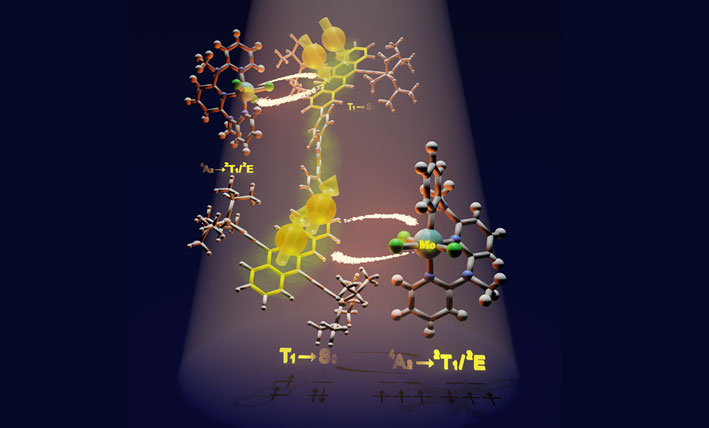
A research team at Kyushu University just pushed past a 65-year-old ceiling in solar physics. Their system produced 130% quantum yield: more usable energy carriers than the photons it absorbed. Still a proof of concept, tested in solution rather than in a working panel. But the mechanism is genuinely new.
The ceiling
Every solar cell faces the same constraint. Infrared photons don’t carry enough energy to activate electrons. High-energy blue photons carry more than needed, and the surplus bleeds away as heat. The net result: conventional cells convert roughly a third of incoming sunlight into electricity. This is the Shockley-Queisser limit, and it isn’t an engineering flaw. It’s a consequence of how semiconductors interact with light. Building a better panel doesn’t move it. You need different physics.
The trick: split one photon into two
The Kyushu team, working with collaborators at Johannes Gutenberg University in Germany, pursued a quantum process called singlet fission. Normally, one photon produces one exciton: a bound electron-hole pair that carries energy. In singlet fission, that single excited state splits into two lower-energy triplet excitons. One photon in, two energy carriers out. In theory, this pushes efficiency well past 100%.
The problem: before that split can do any good, a competing process called Forster resonance energy transfer (FRET) steals the energy away to nearby molecules. FRET is fast and indiscriminate, and it had made singlet fission nearly impractical for years.
The fix
The team engineered an energy acceptor that FRET simply can’t reach. They designed a molybdenum-based “spin-flip” metal complex, a molecule where an electron changes its spin state during light absorption. That spin behavior makes it selectively attractive to triplet excitons specifically. FRET targets singlet states. The spin-flip emitter waits for the triplet pairs produced after fission and ignores everything else.
By carefully tuning the energy levels between tetracene (the singlet fission material) and the spin-flip emitter, the multiplied excitons transferred efficiently to the acceptor while FRET was locked out.
130%
For every 100 photons absorbed, roughly 130 metal complex emitters activated. More energy carriers than incoming photons. The Shockley-Queisser limit assumes one photon produces at most one electron. This system, in solution, produces more than one.
Associate Professor Yoichi Sasaki put it plainly: “We have two main strategies to break through this limit. One is to convert lower-energy infrared photons into higher energy visible photons. The other, what we explore here, is to use singlet fission to generate two excitons from a single photon.”
The paper was published in the Journal of the American Chemical Society on March 25, 2026.
What it isn’t yet
This was a solution-phase demonstration. The components are dissolved in liquid, not layered into a panel. Moving to solid-state systems changes molecular packing, energy transfer distances, and material tolerances in ways the team is still working through. A production-ready panel based on singlet fission is years away, minimum.
Why it matters
The panels available today, including every kit in our recommended list, operate within the Shockley-Queisser limit. They’re reliable and get cheaper every year. Plug-in solar makes financial sense right now, independent of where the research frontier sits.
But the ceiling is moving. For 65 years, “one photon, one electron” was treated as a law of nature. It isn’t. It’s a property of conventional materials, and it has a workaround. That’s worth knowing.
Source: Kyushu University / Journal of the American Chemical Society, March 2026.





Leave a comment