
The sun has been fusing hydrogen in its core for 5 billion years. Every hour, enough of that energy lands on Earth to power all of human civilization for a year. Solar panels convert a slice of it into electricity using a physics trick that requires no moving parts, no combustion, and no fuel. Here’s how it works.
Start with the sun
The sun produces light through nuclear fusion: hydrogen atoms collide under extreme pressure in the core, form helium, and release enormous amounts of energy. That energy takes hundreds of thousands of years to work its way to the sun’s surface, then eight minutes to reach Earth.
Einstein worked out in 1905 that light travels not just as a continuous wave but as a stream of discrete packets called photons. Each photon carries a specific amount of energy determined by its frequency. Blue photons carry more than red ones. This turns out to matter a great deal for how solar panels work.
Why silicon
Silicon is the second most abundant element in the Earth’s crust. Sand is mostly silicon dioxide. Its abundance makes it cheap. Its atomic structure makes it useful.
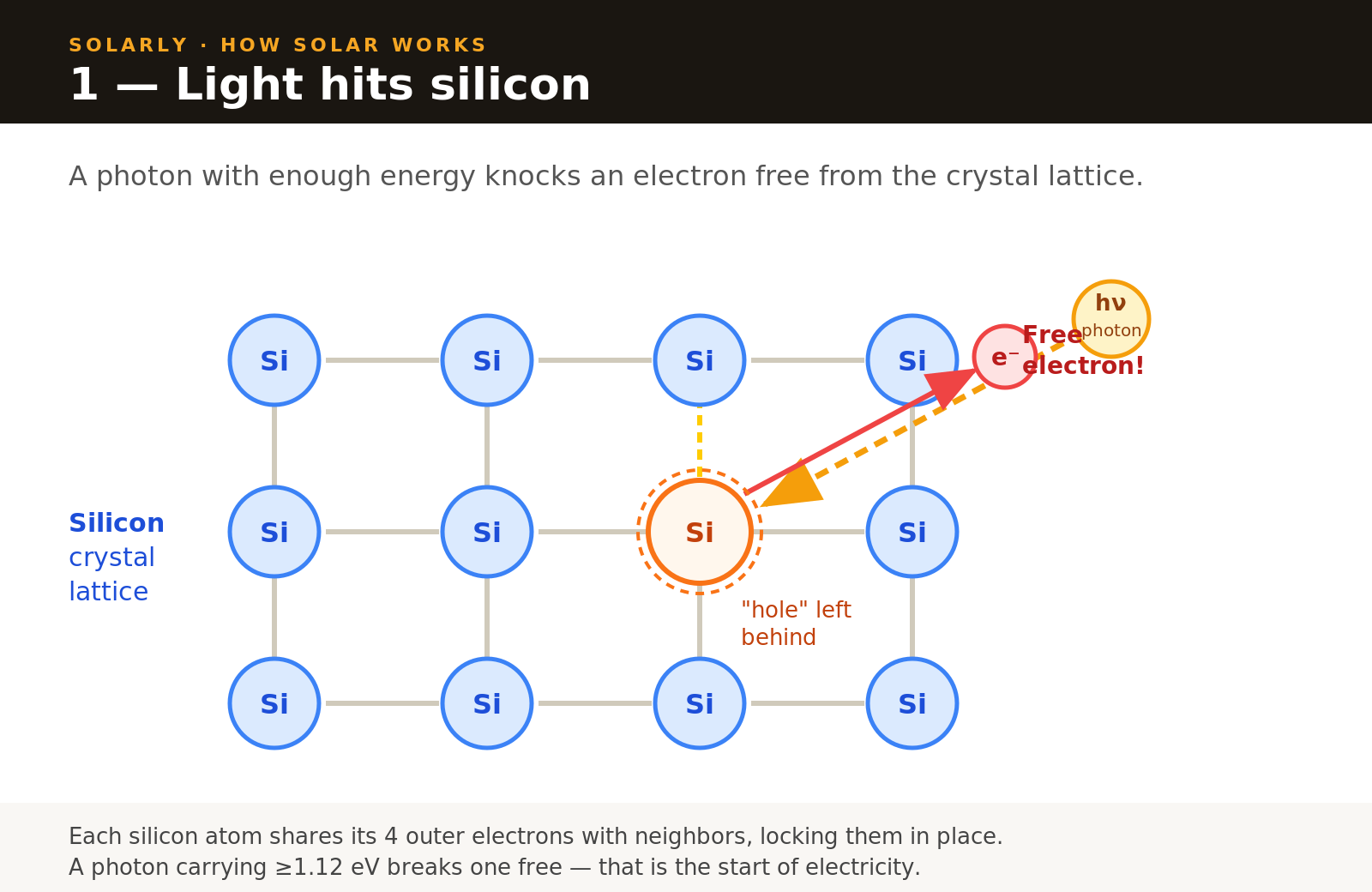
A silicon atom has 14 electrons. The four outermost, called valence electrons, are the ones that matter. When silicon atoms bond together, each shares a valence electron with each of its four neighbors. These shared electrons hold the crystal together in a rigid lattice. This is what the dark blue wafers in a solar panel are made of.
Pure silicon is a poor conductor. Its electrons are locked up in bonds. But hit the lattice with a photon carrying enough energy and you knock an electron free. That free electron is what we want.
The bandgap
Every material has an energy threshold called the bandgap. Below it, photons just turn into heat. Above it, they free an electron. Silicon’s bandgap is 1.12 electron volts, which corresponds to near-infrared light.
This is close to optimal for converting sunlight. Shockley and Queisser worked out the math in 1961: for a single-layer silicon cell, the theoretical efficiency ceiling is about 33%. Real panels today land between 20% and 23%. The gap comes from surface reflections, electrons recombining before they can be captured, and other real-world losses.
Multi-layer cells can exceed 40% efficiency by stacking semiconductor materials each tuned to a different slice of the spectrum. They’re used in spacecraft where cost doesn’t matter. For everything else, silicon at 20–23% is the right trade-off.
The actual trick: doping
Free electrons alone don’t produce electricity. For current to flow, electrons need to move consistently in one direction. This is where doping comes in.
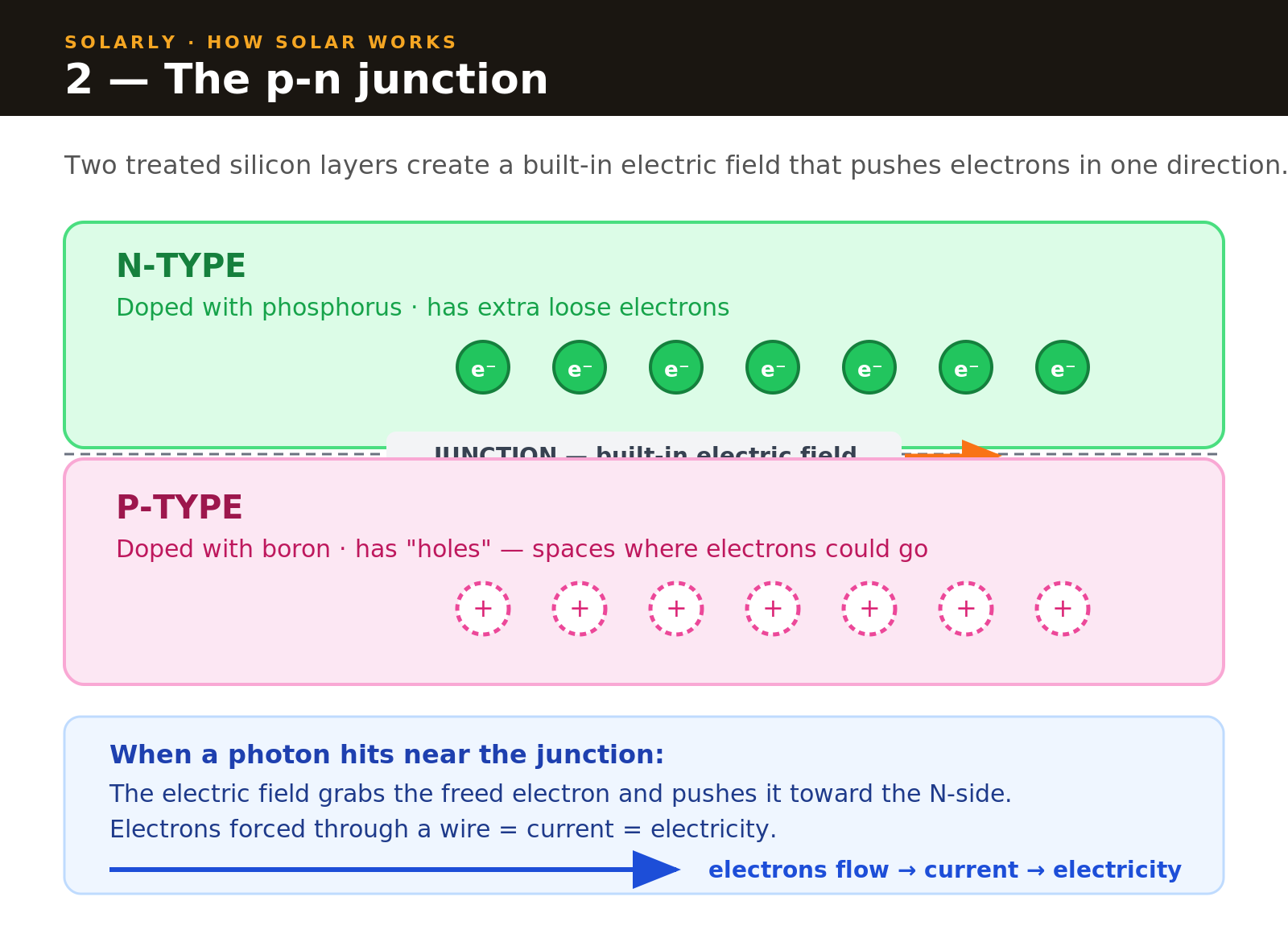
A solar cell is a slice of silicon crystal with two distinct regions. One is doped with phosphorus, which has five valence electrons, one more than silicon needs. That extra electron has no bond to join, so it sits loosely and is ready to move. This is the n-type (negative) layer. The other region is doped with boron, which has only three valence electrons. The missing electron leaves a positively charged vacancy called a hole. Electrons naturally migrate toward holes. This is the p-type (positive) layer.
Where the two regions meet at the junction, electrons from the n-side diffuse across and fill holes on the p-side, creating a thin depleted zone and a built-in electric field. When a photon frees an electron near that junction, the field grabs it and pushes it toward the n-side. That separation drives electrons through a wire. That is current. That is electricity. This is the photovoltaic effect.
From the panel to your outlet
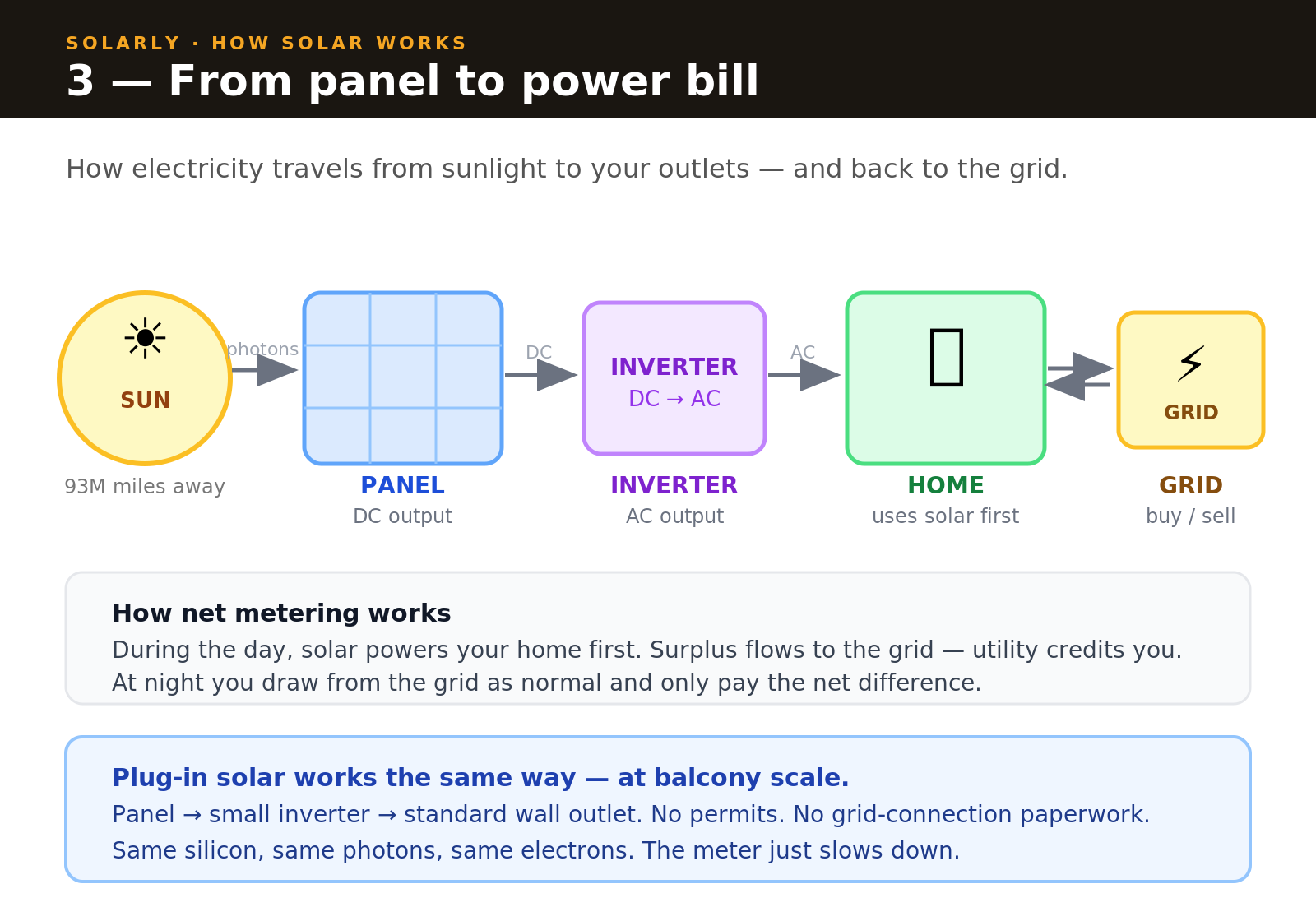
Panels produce DC (direct current): electrons flow in one direction. Your home runs on AC (alternating current): the direction reverses 60 times per second. An inverter, a box usually mounted near your electrical panel, handles the conversion.
Your home uses what the panels produce first. If they generate more than you’re consuming, the excess flows back into the grid and your meter runs backward. Your utility credits you for the export. At night, you draw from the grid as usual. This is net metering.
Plug-in solar works the same way at a smaller scale. A 400W panel on your balcony connects to a small inverter, converts DC to AC, and plugs into a standard wall outlet. Your home uses that power before pulling from the grid. Your meter slows down. Your bill drops.
Why solar got so cheap
There’s a pattern in manufacturing called Wright’s Law: for every doubling of cumulative production, costs fall by a fixed percentage. Solar is one of its most dramatic demonstrations. Module prices have dropped roughly 20% for every doubling of global production, and roughly 99% since 1970.
Two things accelerated the curve beyond what economics alone would predict. China made a strategic decision to scale solar manufacturing, driving prices through sheer volume. And because solar cells are made from the same silicon as computer chips, decades of semiconductor fabrication advances spilled directly into solar.
Today, the panel itself is the cheap part. In the US, the silicon module accounts for roughly 13% of a rooftop system’s total installed cost. The rest is labor, permitting fees, and overhead. These soft costs haven’t fallen anywhere near as fast as the panels, which is why the same hardware costs significantly less installed in Germany or Australia than in the US.
What’s still hard
The physics works. The hardware economics work. The hard parts are elsewhere.
The electric grid was built around a small number of large, controllable power plants. Millions of small rooftop generators that only produce power in daylight is a different system. When solar output drops at sunset, the grid has to spin up replacement power quickly. The fastest-responding plants tend to burn natural gas.
The solutions exist: grid-scale batteries are getting cheaper, better interconnections spread generation across time zones, and a mix of solar, wind, hydro, and nuclear is more resilient than any single source. But they’re slow.
Permitting adds another layer. At the end of 2024, nearly 1,000 gigawatts of solar and wind projects were sitting in US interconnection queues waiting for permission to plug into the grid. That’s roughly three-quarters of the country’s entire generating capacity in a waiting room.
None of this stops you from putting a panel on your balcony today. The physics of plug-in solar is identical to utility-scale solar: same silicon, same bandgap, same photovoltaic effect, same electrons. A plug-in kit bypasses the permitting and grid-connection process entirely. You plug into a wall outlet. The meter slows down.
The technology isn’t waiting. The electrons don’t care about the queue.




Leave a comment