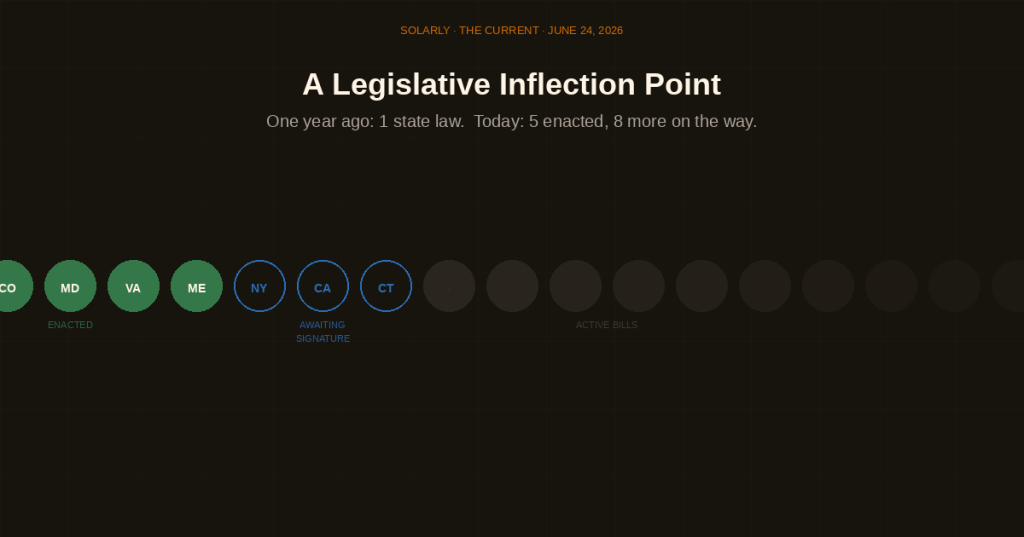
A year ago, one state had a plug-in solar law. Today it’s five. By the time this year’s governor signatures are in, it could be eight. Something has shifted.
Update, September 4, 2026: This was our mid-year survey, and the map has moved a good deal since it ran. Connecticut, Vermont, New Hampshire and New Jersey have all signed in the months since, which makes nine states with a plug-in solar law on the books, and just two bills, California’s SB 868 and New York’s SUNNY Act, are still waiting on a governor. The numbers below are where things stood on June 24.
This time last year, plug-in solar had a single law to its name. Utah had passed HB 340 in March 2025, a quiet, almost technical piece of legislation that exempted small plug-in solar systems from utility interconnection rules. It was historic. It was also alone.
Twelve months later, that law has four companions. Colorado. Maryland. Virginia. Maine. All signed in 2026, four of them within a six-week window in April and May. And sitting on three governors’ desks right now: New York, California, and Connecticut, each having passed both legislative chambers with margins that suggest not “if” but “when.”
What changed? A lot, and all at once.
The Five Laws
Each of the enacted states has done something slightly different. Utah and Maryland set the 1,200-watt limit that has become the de facto standard for the movement. Virginia and Maine followed the same spec. But Colorado broke the mold.
-
Utah Enacted
HB 340 · 1,200W · Effective May 2025 · The first. No utility approval, no interconnection agreement, no fees.
-
Colorado Enacted
HB26-1007 · 1,920W · Signed May 7, 2026 · The highest wattage limit of any US state, 60% above the 1,200W standard. Allows up to four panels without utility permission.
-
Maryland Enacted
HB 1532 (Utility RELIEF Act) · 1,200W · Signed May 12, 2026 · Utilities may request documentation but cannot require prior approval or charge interconnection fees.
-
Virginia Enacted
1,200W · Signed April 2026, effective January 1, 2027 · UL certification required.
-
Maine Enacted
1,200W · Signed April 2026, effective July 2026 · Part of a Northeast cluster that includes New York and Connecticut moving in the same session.
Colorado’s 1,920-watt ceiling is worth pausing on. The bill passed the House 48–16 and sets a new benchmark for what the standard could be. At 1,920W, you’re no longer talking about a single panel supplementing your electricity bill; you’re talking about a meaningful portion of a household’s consumption. If other states follow Colorado’s lead on wattage, the economics of plug-in solar change considerably.
Three More on the Edge
The bills awaiting signature are not close calls. They are, by any reasonable read, done.
-
New York Awaiting signature
SUNNY Act · Passed both the Senate and Assembly · Awaiting Governor Hochul, who has until end of 2026 to sign or veto · On June 14, the New York Times ran an opinion piece calling for exactly this access for renters and apartment dwellers.
-
California Awaiting signature
SB 868 · Passed the Senate 35–1 · Cleared Assembly committees 18–0 · Would cover roughly 17 million renters, the largest renter population of any state.
-
Connecticut Awaiting signature
HB 5340 · 1,200W · Passed both chambers June 4, 2026 · Awaiting the governor’s signature.
Together, these three bills cover an enormous share of the US renter population. California alone has about 17 million renters. New York City is the largest renter market in the country. Connecticut is small by comparison, but it completes a functional Northeast bloc: Maine law already in effect, Connecticut and New York imminent.
The political dynamics are telling. SB 868 cleared the California Senate 35–1. HB 5340 in Connecticut passed both chambers. These are not squeaker votes. The legislative opposition to plug-in solar, which historically came from utility interests arguing grid stability, has collapsed in most of these states. The arguments didn’t hold up when Utah demonstrated that small-scale plug-in systems pose no meaningful grid risk.
Why Now?
The acceleration in 2026 isn’t random. A few things converged.
First, Utah gave everyone a proof point. A real-world law, in effect for over a year, with zero grid incidents. When the utility sector’s worst-case scenarios failed to materialize, the political risk of voting yes dropped sharply.
Second, the economics have become impossible to ignore. Electricity rates have risen steadily. The payback period for a basic plug-in solar setup (a single 400W panel and a microinverter) is now under three years in most high-rate states. At Hawaii’s average rate of $0.35/kWh, it’s faster still. Legislators are hearing from constituents who want to do something about their bills and can’t afford full rooftop installation.
Third, the framing has shifted. This is no longer primarily a “green energy” story. It’s a renter rights story, a consumer protection story, a utility bill story. That reframing expanded the coalition of people who care about it passing.
What’s Not Moving, And Why It Matters
Wyoming voted down its bill in February 2026. Oregon’s bill didn’t advance. Missouri’s HB 2444 stalled in committee. These aren’t surprises; they track closely with states where utility influence over state legislatures remains strongest, and where the political will to override it hasn’t yet materialized.
The pattern of which states are moving and which aren’t tells a fairly clear story: high electricity rates plus high renter populations plus a legislature willing to push back on utilities equals a plug-in solar law. Where one of those three elements is missing, the bills struggle.
The 32 states with no active legislation aren’t necessarily hostile; most have simply not yet had a champion willing to run the bill. That’s a very different problem than principled opposition, and it suggests the map will continue to fill in.
What to Watch
The next few months will clarify a lot. Governor Hochul’s decision on the SUNNY Act is the highest-profile pending action; New York signing would make the Northeast a de facto plug-in solar zone and give advocates a major political win to build momentum elsewhere. California’s signature, when it comes, will be the largest single expansion of plug-in solar rights in US history.
Illinois (SB 3104, out of committee) and Massachusetts are the likeliest candidates to join the enacted column before year’s end. Hawaii, with the highest electricity rates in the country at $0.35/kWh, has both introduced legislation and the strongest economic case of any state yet to pass a law.
The question is no longer whether plug-in solar will become a recognized legal category across the US. It will. The question is how fast, and whether the wattage limits will stay at 1,200W or follow Colorado toward something more ambitious.
We track the full state-by-state picture in real time at the State Laws tracker. If you want to know what the math looks like for your state specifically, run the savings calculator.





Leave a comment