← The Current · November 10, 2026 · How solar works · 4 min read
June is the weakest month of the year for a vertical south-facing panel in nine of the ten cities we modeled, because the sun is too high to land on the glass. Those same nine cities make more in December than in June, which is good to know if a kit is headed to your door this winter.
The short version. In our model, a vertical 400-watt panel on a south-facing railing made more in December than June in nine of ten cities, and it beat a panel tilted 30 degrees on a stand in December in all ten. The stand still wins over a full year, by 42 to 66 percent. If your bracket lets the panel lean out so it sits about 60 degrees from flat, you get the strongest December of the three and give up only 4 to 9 percent of the stand’s yearly output.
Why a low sun helps a vertical panel
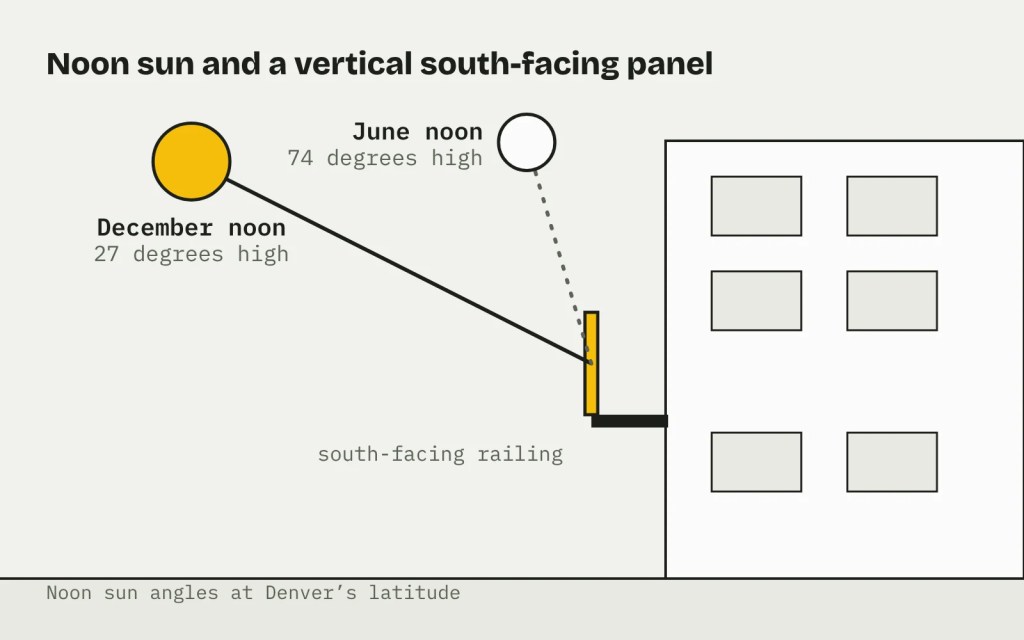
A panel makes the most when light lands square on its face. At noon around the winter solstice in Denver, the sun is about 27 degrees above the horizon, so it comes in low and strikes a vertical panel at about 89 percent of head-on strength. In June the noon sun climbs to about 74 degrees, and the light skims down the glass at about 28 percent. A panel on a stand tilted 30 degrees does the reverse: about 97 percent at noon in June and about 84 percent in December.
Winter days are shorter and often cloudier, but in most of the cities we checked the better angle more than makes up for it.
Nine of the ten cities favored December
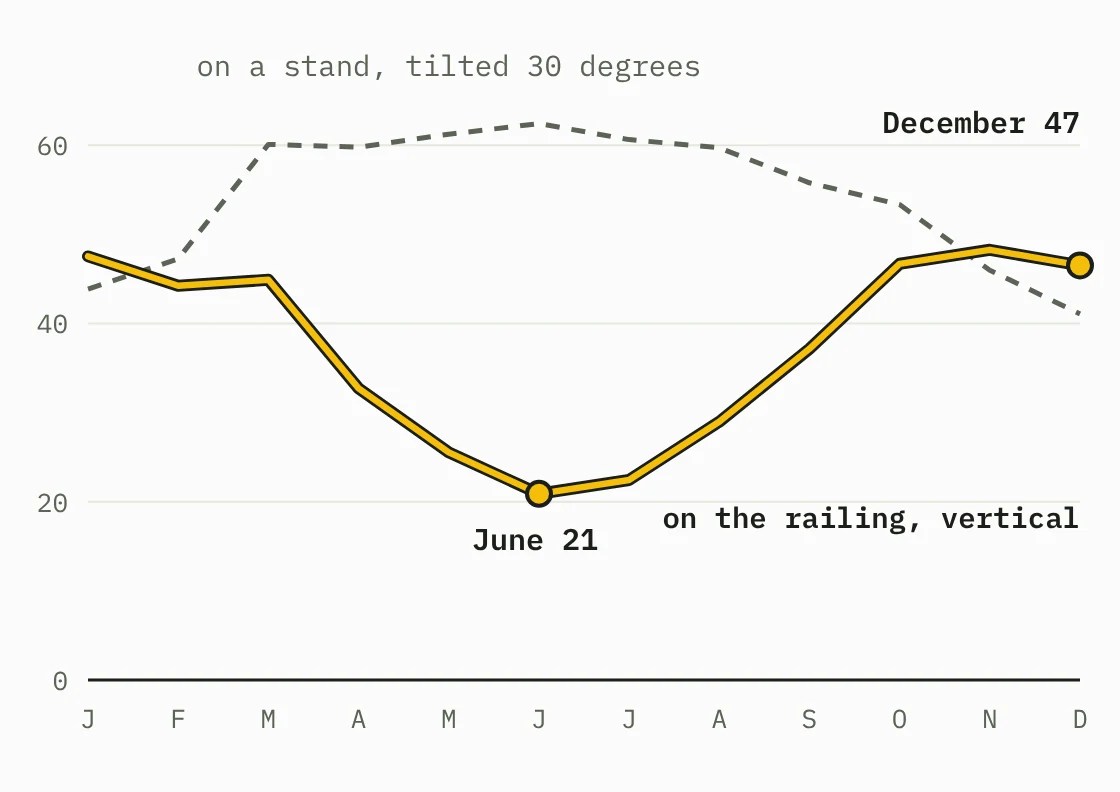
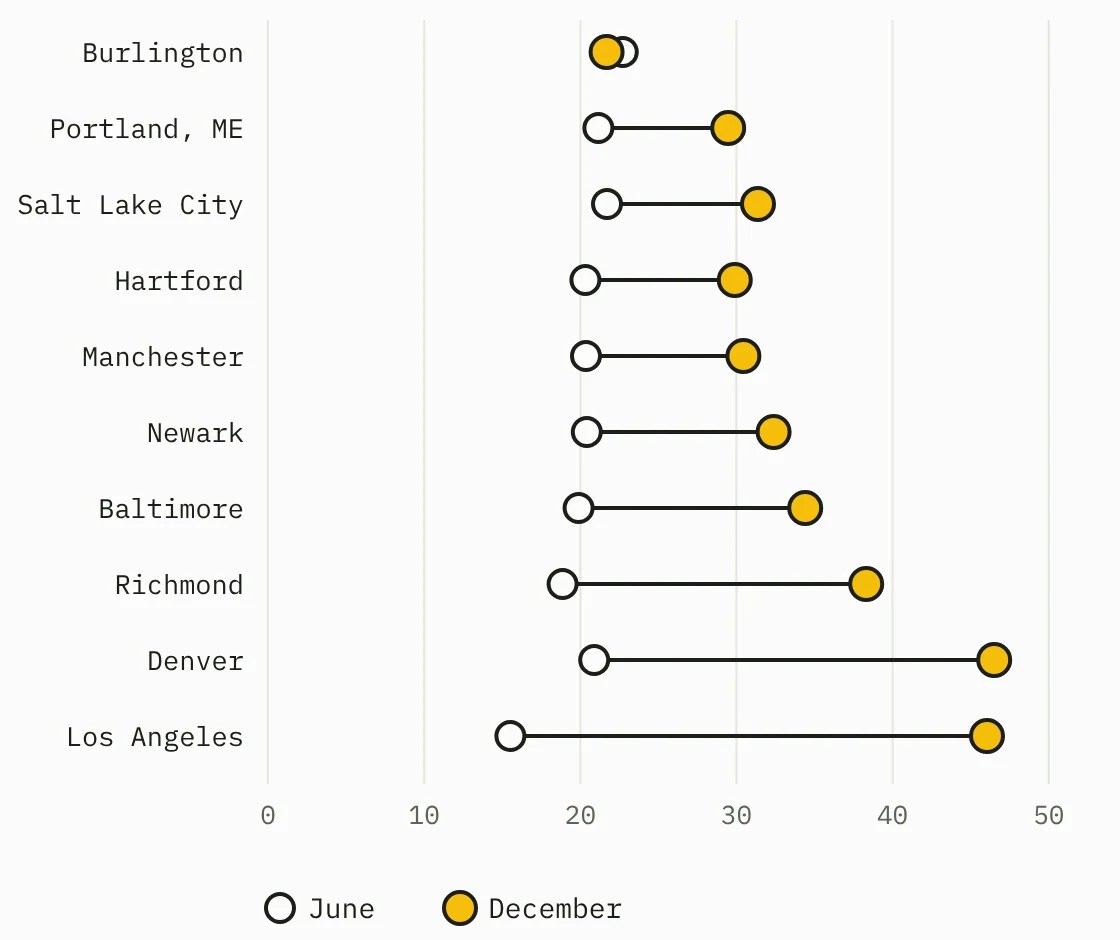
We ran the same panel for one city in each of the ten states that had a plug-in solar law when we pulled the numbers. Los Angeles is the extreme case, at about 46 kilowatt-hours in December and 16 in June, nearly a threefold gap! Denver, Richmond and Los Angeles all peak in November, and Salt Lake City peaks in October. Burlington, Vermont, is about even, with December and June a kilowatt-hour apart, and a second model puts December ahead there too.
What a December of railing power buys
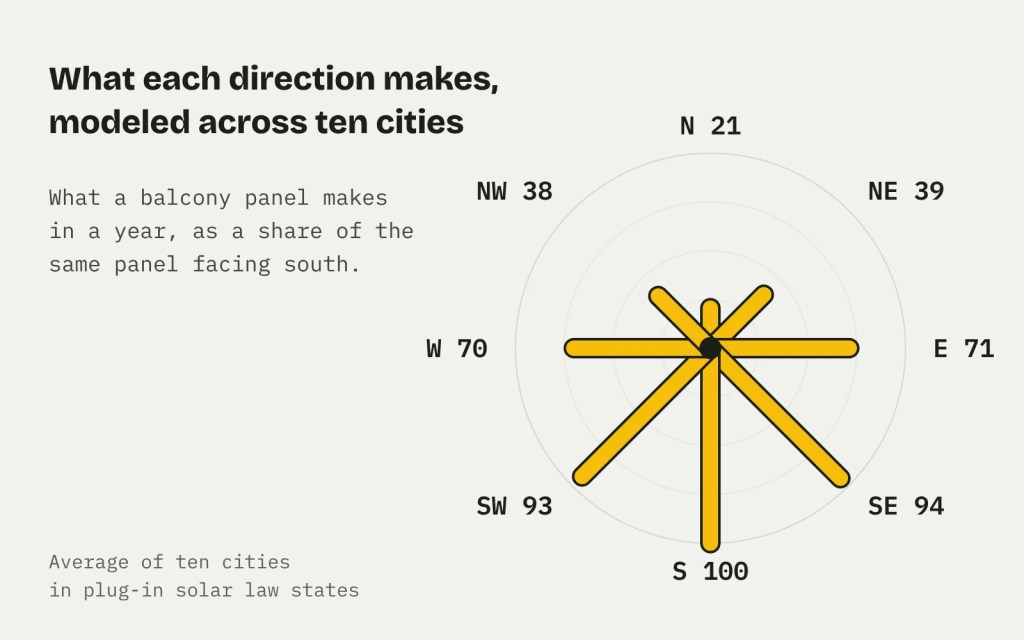
Denver’s railing panel averages about 1.5 kilowatt-hours a day in December, a little more than the 1.34 or so that an Energy Star top-freezer refrigerator uses, a figure from our appliance ledger. That September post also called December the stingier month for a railing panel, and these runs correct that for a vertical mount. Newark comes in near 1 kilowatt-hour a day, and Burlington near 0.7, about half a fridge. A north-facing railing gets none of this, with just 1.8 to 2.7 kilowatt-hours across the entire month.
If your bracket can lean, 60 degrees won every December
| December output, kWh | 30° stand | 60° lean | Vertical rail |
|---|---|---|---|
| Burlington, VT | 19 | 23 | 22 |
| Portland, ME | 25 | 31 | 29 |
| Hartford, CT | 26 | 32 | 30 |
| Manchester, NH | 26 | 32 | 30 |
| Salt Lake City, UT | 29 | 34 | 31 |
| Newark, NJ | 29 | 35 | 32 |
| Baltimore, MD | 31 | 37 | 34 |
| Richmond, VA | 35 | 42 | 38 |
| Los Angeles, CA | 44 | 51 | 46 |
| Denver, CO | 41 | 50 | 47 |
In all ten cities, the panel leaning to 60 degrees from flat made the most in December, and over a full year it made 36 to 51 percent more than a vertical panel. A lean also catches more wind and pushes the panel past the rail, so check the bracket’s rating, your railing and what your lease or HOA allows before you buy. Our kits page notes the mounting that comes with each kit.
What the model leaves out
Snow is the big one, because PVGIS has no snow model, only a flat 14 percent loss figure. A panel on a stand can sit under a drift while a vertical one gives snow nothing to rest on, so the vertical panel’s winter lead over a stand may be larger in places like Burlington and Portland, Maine. Shade from the building next door isn’t in here either. These are modeled figures, too. We reran the vertical panel in PVWatts, the federal solar model: December beat June in all ten cities, including Burlington, and yearly totals landed within about 10 percent of PVGIS, so we’d trust the pattern more than any single kilowatt-hour.
The Solarly Advisor runs PVWatts for your own address, so expect a slightly different number than ours. It asks which way your panel faces and whether it hangs on a railing or stands on a patio; it doesn’t model a 60-degree lean.
How we ran this. PVGIS 5.2 from the European Commission’s Joint Research Centre with its NSRDB solar dataset, for a 400-watt crystalline panel with 14 percent system losses, facing true south, using NSRDB weather years 2005 to 2015 with terrain horizon on. Cities: Burlington, Portland (Maine), Hartford, Manchester, Newark, Salt Lake City, Baltimore, Denver, Richmond and Los Angeles. Noon sun angles are calculated for Denver’s latitude. Checked November 9, 2026.
By Ben van der Veen. Solarly is independent and reader-supported.


Leave a Reply